SUMMARY
Organized by the InTerLUD program - Acting for sustainable urban logistics (Tuesday, November 08, 2022 - 10 to 12 noon)
InterLUD approach
Cerema and Logistic-Low-Carbon are raising awareness of urban logistics issues among local authorities and economic players, and helping them to implement the voluntary commitment to sustainable urban logistics in their areas. Under the aegis of the French Ministry of Transport, the program (2020-2022) is financed by Energy Savings Certificates.
How can we improve the logistics performance of short local circuits in urban environments? How can we increase the food resilience of communities? What role should the various players in the logistics chain play? What regulatory changes are needed to guarantee the freshness of food products, while reducing pollutant emissions from transport?
Local authorities, inter-professional organizations and solution providers will come together to present their feedback, best practices and avenues for action in response to new regulations (EGalim 2 Law - Climate and Resilience Law).
-
BACKGROUND AND LOGISTICAL CHALLENGES
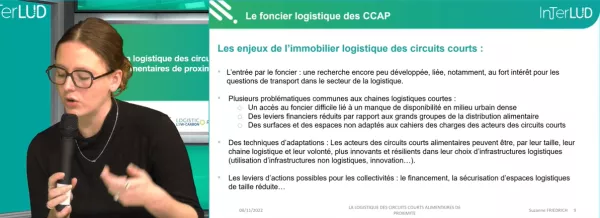
Challenges for producers, supply chains and local authorities presented by Suzanne FRIEDIECH - Laboratoire Ville Mobilité et Transport and Chaire Logistics city.
Observation: the time and costs involved in logistics and transport can be limiting factors in the development of short distribution channels (logistics costs can represent between 20 and 40% of producers' sales). Major challenge = reducing the carbon footprint is very complicated when there are a multitude of players / movements.
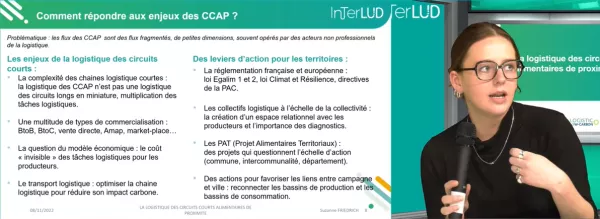
Certain levers can help territories. It's essential to create relational spaces (producers, wholesalers, transporters, consumers). We need to take stock of the existing situation to find ways of cooperating and organizing ourselves more effectively. Territorial Food Projects can help by enabling these exchanges, but they need to be carried out at the right territorial scale to be truly effective. Another key issue is land for short-distance logistics chains.
(To find out more - Link to Suzanne Friediech's dissertation: https: //www.lvmt.fr/chaires/logistics-city/)
-
TERRITORIAL FOOD PROJECTS
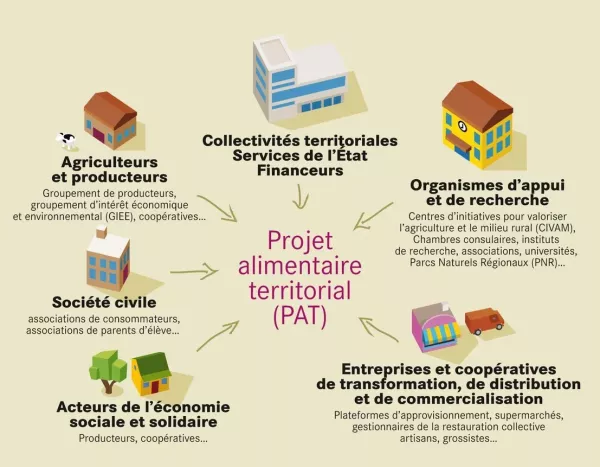
PAT - Bringing together players to organize agricultural, agri-food and logistics production networks. Objectives: strengthen territorial resilience, food autonomy and reduce the carbon footprint associated with food. They encourage the installation of farmers, the development of short circuits and the supply of local products (particularly in canteens or collective catering: EPHAD, hospitals...).
In France, there are some 403 TAPs on very different scales (rural, metropolitan, departmental). Various players are involved: local authorities, producers, processing and SSE companies, as well as Chambers of Agriculture and trade associations.
Illustrations
Example PAT du Havre - development of a digital platform ("cartography") to identify local producers and distributors. Cf. PAT de l'Agglomération Havraise.
TestimonialPAT de la C.A. du Grand Angoulême: espace test agricole pour se former (agriculteurs > une SCIC animime le site), accompagner les changements de pratiques agricoles, animation du réseau " bien manger à la cantine " (car la CAGA n'exerce pas la compétence en direct), répertoire des acteurs proposant circuits-courts et produits locaux, etc.
Marché d'intérêt local" project: offer wholesale of local products to restaurateurs and the food trade. Bring together PAT players (inventory, opportunity study), identify local producers and user needs. It's important to coordinate because there are so many initiatives. A physical platform is not necessarily necessary, because once a producer and a restaurant owner know each other, they can organize delivery between themselves.
Charente Chamber of Agriculture Covid: willingness to move towards short circuits, but only 10% of volumes, Covid has disrupted traditional circuits (fresh produce, canteen closures, etc.) and heightened awareness. Supporting farmers: ecological issues (climate), economic issues (products, quality, fair prices), social issues (attractiveness of the agricultural sector). Platform Think local "platform: interactive map of local producers (farmers, breeders, agri-foodstuffs, etc.), local farmers' markets, points of sale, etc. Logistics: packaging, transport, delivery/sales = these are very different professions from farming.
We work with local authorities on TAPs (to stimulate), the national "Bienvenue à la Ferme" brand (guarantee, quality), and the organization of " gastro-nomades " events. We need to educate consumers, because they have to play the game.
Platform to put producers and consumers in touch, including logisticians to avoid carbon emissions. Organizing logistics is a real challenge!
F&V sector in Centre Val de Loire - Interfel
Observation: Stronger demand for local F&V from distributors and restaurateurs. But logistics and local availability are a problem for certain products (agricultural specializations not always in line with local needs).
Question: Should there be an observatory of short circuits?
Useful for identifying good initiatives. What's being done elsewhere?
What does the consumer want? How do producers make a living from their activity? What do legislators want? Does it give farmers the means?
Cédric BARIOU - Cerema
There are tools for optimizing logistics: Logicoût software, for example > calculating GHGs according to the solution adopted. Environmental labelling? Useful for informing consumers.
Egalim 2 law > increased demand for local produce > offers outlets, but at the margin for small producers as they are not always organized to produce and deliver. Problem: the demand is there, the solutions not yet.
-
CONTRACT CATERING
Silgom's short-distance purchases (Morbihan)
Video testimonial: Syndicat interhospitalier de logistique du golfe du Morbihan(Silgom) - local short-distance supply chains for collective catering: hospitals, Ephad. Approach: Step1 = Meet producers: can they supply us? How much? Step 2: Can they deliver? Are they on the route of someone who already delivers to us? Objective: avoid creating additional logistical circuits.
AgriParis project
Within the framework of the PAT > organize supply chains for canteens and crèches (corresponding to around 30 million meals/year for the City of Paris). NB: Paris is a signatory to the Milan Pact and is committed to ensuring healthy, sustainable and resilient food for all.
Objective: 100% sustainable catering, including 50% local produce (200 km around Paris) by 2027. Approach: broad consultation (citizens, professionals), États généraux de l'agriculture et de l'alimentation durables > identification of issues and expectations, prioritization and definition of the first missions of AgriParis (new operator).

Communication/awareness-raising component, support for the installation of urban and peri-urban farmers...
Public procurement: adapting public procurement to include "local products" in public contracts.
Diagnosis: which players and where? Setting up an Observatory. Analyze and map flows into and out of the region.
Circular economy - bio-waste. Reduce waste.
Consider 1st km (pick-up): wholesalers, stores already supplied > try to optimize / pool. Peri-urban and urban logistics hubs > networking.
Romain BARBÉ - Pau - Short local circuits action
Platform " Mangez béarnais "An association of producers wishing to organize themselves > to supply canteens. Issues: Problem of access to public contracts. Problem of logistics (500 km/week to deliver products, is it profitable?). How do small producers respond to calls for tender?
Delivering to central kitchens: price? Can you be sure of the quantities ordered? Which products have local outlets? Sometimes the problem of matching supply and demand. On the public sector side: multiplication of suppliers/invoices (accounting costs), etc.
Solution: Logistics platform exists (local carrier) that can handle order preparation, delivery and invoicing.
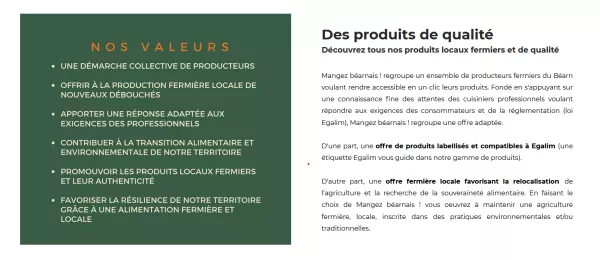
Action sheet > short circuits and actions to be implemented to meet the challenges. E.g.: green belt (encouraging organic market gardening, sales to individuals), tools available (crates, prepared orders).
Action sheet > short circuits and actions to be implemented to meet the challenges. E.g.: green belt (encourage organic market gardening, sales to individuals), tools available (crates, prepared orders).
FEDALIS - Normandy
In Normandy, the "Eating Normandy" initiative (launched by the Region). Creation of a canning factory, but how to organize deliveries? Role of the wholesaler > existing, cheaper network. Wholesaler of fish products to ensure "Norman fish" for Friday school lunches > What volumes of fish are available at the start of the week? For example, weather conditions don't always allow us to supply the quantities ordered.
FEDALIS: preparation / freezing / storage of fillets in case of shortage. Interest of tripartite contractualization > securing the producer by going through the wholesaler, as canteen catering, for example, is only 140 days/year.
Problem: how to secure the supply of fresh produce? Big producers have total traceability, but small producers don't have this "culture" or these legal obligations. But transporters do.
-
DIGITAL TOOLS
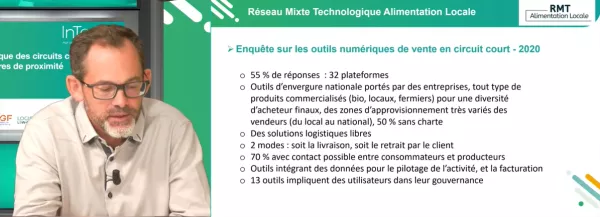
According to a survey carried out by Cerema, there were almost a hundred short-distance sales platforms in 2020, developed by both private and public players.
LOGICOÛT
ObSAT
Observatory of Territorialized Food Systems.
A tool to help local authorities diagnose the existing situation (producers, sales outlets, etc.) and consider the relevance of launching an initiative. https://obsat.org/


InTerLUD
Le programme InTerLUD est porté par ROZO, Logistic-Low-Carbon, la CGI, le Cerema et l’Agence de la transition écologique (ADEME). Il a pour objectif de mettre en œuvre des chartes de logistique urbaine durable dans 50 métropoles et communautés d’agglomération d’ici trois ans.