SUMMARY
The "Paroles de campagne: réalités et imaginaires de la ruralité française" study, conducted by Destin Commun in partnership with Bouge ton Coq, InSite and Rura, aims to gain a better understanding of the lived realities, perceptions and aspirations of people living in rural areas. In the face of persistent clichés and feelings of invisibilization, it seeks to restore the voice of rural people to its rightful place in public debate.
Today, 21.5 million people live in rural France, representing almost 33% of the population.
The survey is based on a mixed methodology combining a representative quantitative survey (3,532 people, including an over-sample of 1,557 rural dwellers, identified by geo-referencing) and group interviews conducted in several rural areas, in order to cross-reference data with real-life accounts. It also mobilizes the tools of social psychology to analyze in depth the representations, identity narratives and feelings of relegation or injustice felt by some of the inhabitants.
Among its key findings, the study also shows that rural dwellers are often less rooted in their territory than might be thought, and that their residential trajectories are just as mobile as those of urban dwellers, thus deconstructing the idea of a fixed or immobile rurality.
Keywords: residential attractiveness, study, pride, inhabitants, cultural identity, residential mobility, perception, social pyschology, narrative, rurality, rural, urban.
Illustration: © Destin Commun
Social psychology analysis: the Destin Commun typology
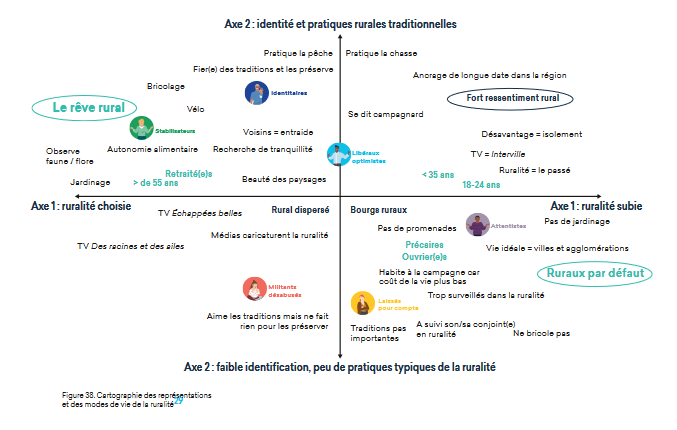
Within this framework, the study identifies six major families of values that structure rural sensibilities:
- Disillusioned activists (12% of rural dwellers): Younger, educated, cosmopolitan, sensitive to inequalities, pessimistic, secular.
- Liberal optimists (6%): Younger, individualistic, pragmatic, confident, entrepreneurial.
- Attentists (12%): Younger, detached, individualistic, uncertain, disengaged.
- Stabilizers (16%): Moderate, settled, committed, rational, compassionate, ambivalent.
- Left Behind (26%): Angry, defiant, feel abandoned, disengaged.
- Identitarians (28%): Older, conservative, declinist, nativist, uncompromising.
Lives on the move: overcoming the myth of rural roots
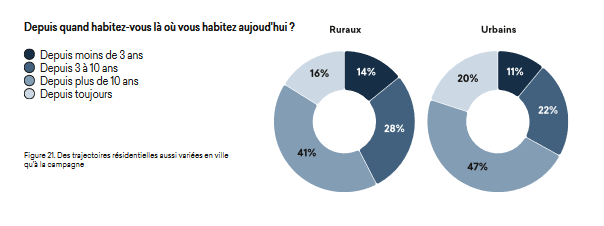
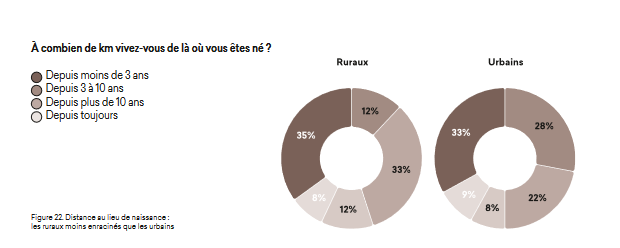
Contrary to the clichés of entrenched rural dwellers, the figures show a rural population that is actually more mobile than urban dwellers. Only 16% of rural dwellers now live where they have always lived, compared with 20% of urban dwellers. Urban dwellers are also twice as likely to live less than 10 km from their birthplace (28%, versus only 12% of rural dwellers). The life courses of rural dwellers are more open, more composite than we might imagine. Rurality is not an assignment, it's a trajectory - often chosen, but also sometimes undergone, due to the metropolization of training and employment opportunities, which forces rural dwellers to move closer to the cities and multiply the number of return journeys.
Source: DESTIN COMMUN - "Paroles de campagne" study (p. 56)