ABSTRACT
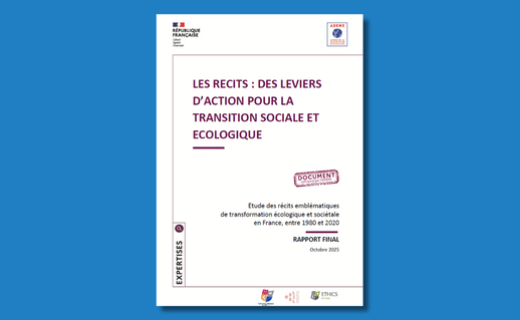
This report, prepared by Albin WAGENER (Catholic University of Lille) for ADEME, offers a unique analysis of the narratives underlying French ecological and social transition initiatives launched between 1980 and 2020. The starting premise is anthropological: every human society constructs its relationship to the world and to action through narratives, and the ecological transition is no exception to this rule. The study begins with a central observation: it is not that there is a lack of narratives surrounding the transition, but rather that their profusion and confusion can hinder communication.
The study concludes that narrative should no longer be viewed as a mere accessory to communication, but as a fundamental—almost political—component of socio-ecological transformation. Narratives and actions influence one another within a systemic framework: there is no action without a narrative to underpin and guide it, and conversely, structured narratives make it possible to replicate local initiatives and adapt them from one region to another. The report thus urges decision-makers, local governments, and project leaders to integrate storytelling from the very outset of their initiatives—rather than treating it as a post hoc communication step—while emphasizing that there is no single narrative capable of driving all transformations, but rather a diversity of narratives tailored to specific regions, sectors, and local cultures.
Keywords: local public action, agriculture, sustainable food systems, associations, biodiversity, local governments, cooperatives, culture, participatory democracy, eco-spaces, circular economy, social and solidarity economy, ESS, education, renewable energy, sustainable housing, local identities, citizen engagement, social innovation, sustainable mobility, lifestyles, stakeholders, emblematic narratives, awareness-raising, solidarity, storytelling, rural areas, peri-urban areas, urban areas, third places, socio-environmental transformation, cultural transition, ecological transition, social transition, values, Metropolitan France, Overseas Territories.
Illustration: © ADEME
Methodology, Recommendations, and Leverage Points for Action
Methodology
Methodologically, the research team first identified 927 initiatives using cross-referenced sources (the RARE network of regional energy agencies, Carteco’s mapping of the social and solidarity economy, France Tiers-Lieux’s mapping, specialized media outlets such as Vert and Reporterre, and supplementary research). This corpus was then narrowed down to 846 initiatives established between 1980 and 2020, and then refined to 559 initiatives that met all three source requirements (statements from the stakeholders themselves, partner sources, and media coverage), after excluding cases marred by major difficulties (closures, legal disputes, or proven greenwashing). The texts collected for these 559 initiatives (approximately 19.6 million characters) were analyzed using the lexical-metric software Iramuteq, which measures occurrences, co-occurrences, and thematic classes, cross-referenced with variables such as region, department, type of territory, legal form, sector of activity, and year of establishment.
4 Recommendations
- Highlight a desirable social bond by linking the ethics of “care” with the hedonistic dimension of the community.
- Emphasize the connection to the local area, drawing on local identities, the living environment, food, and mobility to foster a sense of belonging.
- Propose genuine economic, social, or democratic alternatives, rather than mere cosmetic adjustments to the existing model.
- Propose an “amplifying” ecology—that is, an ecology linked to social and economic dimensions rather than driven solely by activism—in order to reach a broader audience than those already convinced.
4 Operational Leverage Points
In addition, four concrete levers are proposed for on-the-ground actors and decision-makers:
- Prioritize actions that are engaging and experiential rather than purely informative
- Use storytelling as a tool for diagnosing and evaluating projects, on par with traditional indicators
- Systematically document the storytelling surrounding initiatives—a “blind spot” identified by the study despite its cultural significance
- Remain attuned to emerging narratives—for example, through a narrative observatory—to identify counter-narratives that hinder certain dynamics.
To find out more :
- Olivier BOUBA-OLGA, 2019, *Toward a New Territorial Narrative*, POPSU Conferences.
- CERDD, May 5, 2025, DDTour #11 | Lomme: How to Engage Citizens on the Path to a City in Transition.
- CERDD | Download the CERDD’s educational activity kits: Carto Party, Visée 360°, and Mise en récits.
- Parlons Climat, sept. 2026, La transition écologique à l’âge des preuves.