SUMMARY
The GTCI report is published annually byINSEAD, this year in collaboration with the Portulans Institute, an American think tank specializing in digital transformation and innovation indicators.
It is abenchmark analysis that measures how countries and cities develop, attract and retain talent. The visual below, taken from the report, presents the new conceptual framework of the GTCI model, which evolves from previous editions to incorporate the impact of generative artificial intelligence and the notion of resilience (individual as well as institutional and collective). It places resilience at the heart of the analysis, defining it not simply as the ability tobounce back, but as the ability tobounce forward - i.e., to transform positively under the impact of shocks. It combines an assessment of what countries are doing to produce and acquire talent(Input) and the type of skills they have as a result(Output). The 2025 edition covers 135 countries and 77 standardized indicators that enable them to be compared.
Keywords: adaptability, talent attraction, international benchmark, skills, education, employability, training, resilience, talent retention, soft skills.
Illustration: © Global Talent Competitiveness Index - INSEAD x Portulans Institute
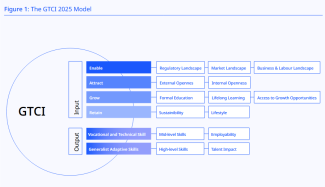
Le GTCI repose sur un modèle à six piliers organisés en deux sous-indices.
Entrées (Input) : quatre piliers qui mesurent ce que les pays font pour développer et attirer les talents :
- Permettre (Enable) : qualité réglementaire, infrastructure de marché, environnement des affaires
- Attirer (Attract) : ouverture externe (immigration, FDI) et interne (tolérance, mobilité sociale, inclusion des femmes)
- Développer (Grow) : éducation formelle, formation tout au long de la vie, accès aux opportunités de croissance
- Retenir (Retain) : durabilité sociale et environnementale, qualité de vie
Sorties (Output) : deux piliers qui mesurent les résultats en termes de compétences :
- Compétences techniques et professionnelles (VT Skills) : compétences intermédiaires et employabilité
Compétences générales adaptatives (GA Skills) : anciennement « Compétences globales de la connaissance », ce pilier est rebaptisé en 2025 pour refléter l'importance croissante de l'adaptabilité, de la fluidité numérique, des compétences douces et de l'intelligence artificielle
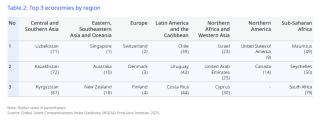
| Région | 1er | 2e | 3e |
|---|---|---|---|
| Europe | Suisse (2) | Danemark (3) | Finlande (4) |
| Asie centrale et du Sud | Ouzbékistan (71) | Kazakhstan (72) | Kirghizistan (87) |
| Asie de l’Est, du Sud-Est et Océanie | Singapour (1) | Australie (10) | Nouvelle-Zélande (18) |
| Amérique latine et Caraïbes | Chili (39) | Uruguay (42) | Costa Rica (44) |
| Afrique du Nord et Asie occidentale | Israël (23) | Émirats arabes unis (25) | Chypre (30) |
| Amérique du Nord | États-Unis (9) | Canada (14) | — |
| Afrique subsaharienne | Maurice (49) | Seychelles (50) | Afrique du Sud (79) |
The 2025 ranking: a reshuffling of the balance
- The most striking feature of the 2025 ranking is Singapore's rise to first place - a first in the history of the index. The city-state dethrones Switzerland (2nd), followed by Denmark (3rd), Finland (4th), Sweden (5th), the Netherlands (6th), Norway (7th), Luxembourg (8th), the USA (9th) and Australia (10th).
- Europe is the dominant bloc: 7 countries in the top 10 are European, and 18 of the top 25 economies belong to the continent. France is ranked 19th (see p. 26 for the world ranking and p. 147 for the monograph). The Nordic countries are a model in their own right - a rare combination of institutional robustness, civic trust, labor market flexibility (the Danish flexicurity model) and massive investment in lifelong learning.
- Of particular note is the fall of the United States (from 3rd to 9th place between 2023 and 2025): the report attributes this to lower scores onExternal and Internal Openness and onLifelong Learning. China also slips down the rankings (from 40th to 53rd place), reflecting vulnerabilities in talent attraction and retention (institutional control VS openness and individual freedoms).
- In emerging countries, the GTCI 2025 identifies " dynamic talent movers " - economies that outperform relative to their income level. The list is instructive: alongside Finland, Sweden and Australia, it includes low-income countries in sub-Saharan Africa such as Malawi, Rwanda, Gambia, Mozambique, Burundi and Madagascar. These countries are "doing better with less", capitalizing on basic education, openness and community-based human capital development mechanisms. This is a sign that the competitiveness of talent is not the prerogative of rich countries.