SUMMARY
Much of the interest in AI and work concerns its possible effects on job losses - will jobs be replaced or transformed by AI? While the technology is still evolving, researchers at the International Labor Organization (ILO-ILO) have developed a methodology to estimate the potential effects of generative AI (GenAI) on existing occupations, and then on employment.
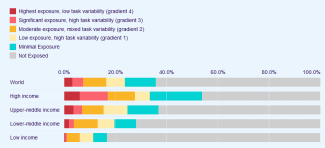
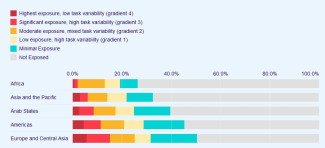
Worldwide, one worker in four is exposed to GenAI. But this proportion increases with income level: 11% of total employment in low-income countries vs. 34% in wealthy countries, due to the typology of jobs. 3.3% of global employment could be at risk (Gradient 4), although with significant differences between women (4.7%) and men (2.4%). These differences also increase with country income (9.6% for women vs. 3.5% for men). In Europe and Central Asia, 32% of employees(136 million jobs) are exposed to GenIA, of which 5.7% are highly exposed. This average conceals a disparity between men and women: 26% of men vs. 39% of women, 3.3% of jobs held by men (61 million) vs. 8.6% of jobs held by women (75 million).
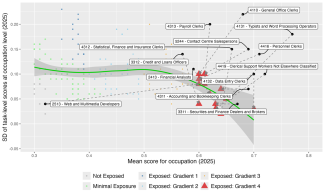
For the time being, job transformation is the most likely impact of GenAI, as most occupations consist of tasks that still require a human contribution. However, some professions are more at risk than others, as they can be easily automated (see chart), and women are much more affected than men.
Keywords: jobs, impact, artificial intelligence, AI, generative artificial intelligence, GenAI, GenIA, professions, work, Europe, World.
Illustration: International Labour Organization ©
Methodology
Using a representative sample of the 29,753 tasks in the Polish occupational classification system, and a survey of 1,640 people employed in each single-digit ISCO-08 group, the authors collected 52,558 data points concerning perceived automation potential for 2,861 tasks. They then compare this data with a survey and several rounds of Delphi-style discussions within a select group of international experts. Based on this process, they created a knowledge repository on task automation that goes beyond national specificities, and used it to develop an AI assistant capable of predicting task scores in ISCO-08 technical documentation.
The results for 2025 are presented in a framework of four progressively increasing exposure gradients (Gradient 1 to 4 - low to high exposure), with a series of global estimates of employment shares exposed to GenAI.
Percentage of jobs exposed to GenAI worldwide, by income and geographical area
Trade show at GenAI