SUMMARY
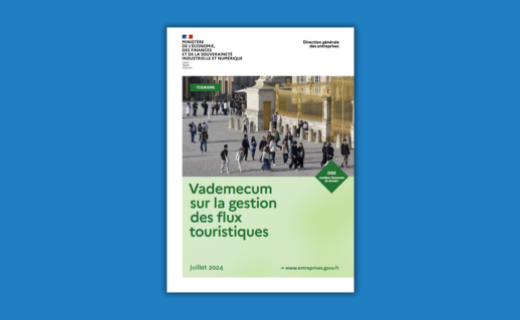
In July 2014, the DGE published a Vademecum on tourism flow management, aimed at tourism players. It presents the eleven levers to be activated, as well as tools and examples of good practice in tourism flow management.
👉Discover the 11 levers identified and the inspiring examples associated with them, as well as the link to access the full publication.
Keywords: social acceptability, tourism developments, flow analysis, territorial attractiveness, carrying capacity, stakeholder consultation, partnership coordination, territorial experiments, territorial governance, integration of local residents, visitor observation tools, resource preservation, local residents' quality of life, tourism regulations, public awareness, sustainable tourism.
Illustration : DGE ©
Find out more about the Vademecum:
A Vademecum is a "document, work, guide in which the main information concerning an activity or knowledge is gathered, and which is usually kept on one's person so that it can be consulted at any time" (source: Dictionnaire de l'Académie française).
This guide identifies 11 levers for managing tourist flows, with which territories that have adopted good practice are associated:
1/ General recommendations
2/ Observation :
- Knowing and analyzing the views of visitors, residents and professionals, and qualifying visitor numbers - Charente Estuary
- Study of visitor numbers in the Vallon de l'Aiguebrun - Parc naturel régional du Luberon
Tool 1: Murmurations (French SME producing dashboards for environmental monitoring, tourism activity management and territorial carrying capacity thresholds).
Tool 2: Outdoorvision (platform for observing the flow of outdoor sports activities)
3/ Governance :
- The Greater Paris destination contract (+ Explore Paris)
- Creation of a working group on knowledge, analysis of visitor numbers and hospitality - Charente Estuary
- Gorges de Galamus project - Corbières-Fenouillèdes Regional Nature Park
- Creation of partnerships via clubs to go beyond administrative boundaries - Charentes Tourisme
4/ Work on the tourism offer:
- Paris Local operation - Paris Je t'aime Tourist Office
- Micro-adventures - Grand Avignon Tourist Office
5/ Developments :
- Setting up a paid parking lot to manage visitors to the Cirque de Saint Même - Communauté de communes Cœur de Chartreuse
- Detour trails: the example of Mornac-sur-Seudre
- Extension of the Ochre by bike itinerary in the Luberon region
6/ Raising awareness / communication / training :
- Example of local knowledge workshops organized by theDieulefit-Bourdeaux Tourist Office in the Drôme Provençale region.
- Digital for flow management in Provence-Alpes-Côte d'Azur (PACA)
- Implementing appropriate communication - the example of theCharente estuary
Tool: Biodiv'Sports to reconcile nature sports and biodiversity
7/ Experiments & innovations :
- Experimenting with a car-free day onAix Island
- Developing new approaches to welcome and hospitality, the example of Oiseaux de Passage - Case study of Marseille's northern districts
- Setting up a mobile tourist reception point - Coeur de Savoie Tourist Office
- Launch of a test project as a pilot territory within the framework of the Avenir Montagne Ingénierie program and support from the Fabrique des Transitions - Luberon Regional Nature Park
8/ Soft mobility and alternatives to the private car:
- House of soft mobility and tourism in Annemasse
- The design of a pedestrian plan co-constructed with local players - l'Isle-sur-la-Sorgue
- DiscoverÎle Madame by horse-drawn carriage
9/ Applicable regulations :
- Application of thresholds for access toIle de Bréhat
10/ Integration of local populations :
- The creation of residents' cooperatives - the example of Marseille's northern districts
- Transforming a tourist office - the example of Comptoir Local Aunis Marais Poitevin
- Developing and preserving the community fabric - the example of Mornac-sur-Seudre
- Rencontres Tourisme & Habitants - the example ofOnlyLyon Tourisme et Congrès
11/ Keys to managing an emergency situation :
- Identification of priority actions by the Grand Site with the Falaises d'Etretat - Côte d'Albâtre
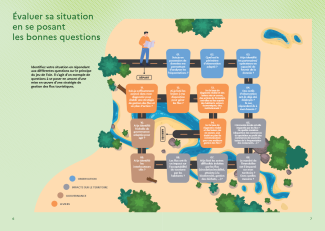
Illustration pédagogique représentant un parcours de réflexion pour la gestion des flux touristiques. Le visuel est conçu comme un chemin sinueux traversant un paysage naturel stylisé (rivière, arbres, végétation), avec un point de départ et un point d’arrivée.
Le titre, situé en haut à gauche, est : « Évaluer sa situation en se posant les bonnes questions ». Un texte d’introduction explique qu’il s’agit d’un outil d’auto-diagnostic, sous forme de jeu de l’oie, pour se poser les bonnes questions avant de mettre en œuvre une stratégie de gestion des flux touristiques.
Le parcours comporte 14 étapes numérotées, présentées sous forme de blocs colorés reliés entre eux, correspondant à des questions clés. Ces questions portent notamment sur :
– la disponibilité et l’analyse des données de fréquentation,
– l’identification des partenaires et opérateurs,
– l’existence et la pertinence des outils d’observation,
– les impacts du tourisme sur l’économie locale, l’environnement, la mobilité et la qualité de vie,
– l’acceptabilité du tourisme par les habitants,
– l’identification des interlocuteurs et de l’échelle de gouvernance adaptée,
– les leviers d’action disponibles,
– la capacité à établir un diagnostic et un plan d’action.
Les blocs sont codés par couleur selon quatre catégories, indiquées dans une légende : observation, impacts sur le territoire, gouvernance et leviers.
L’ensemble illustre une démarche progressive, allant de l’observation initiale jusqu’à la construction d’une stratégie de gestion des flux touristiques.