SUMMARY
The 2026 edition of the SCET-Ancoris barometer paints a worrying picture: business location projects in France fell by 18% in 2025, all sectors combined, reaching their lowest level since 2019 (1,305 projects detected). This slowdown can be explained by two main factors: land constraints, the main structural obstacle cited by 60% of investors, and national political instability, cited by 52% of investors.
However, the majority of local authorities surveyed remain optimistic (80%). Under budgetary pressure, they are refocusing their investments on operational fundamentals - developing the land and real estate offer - to the detriment of events and outward prospecting. The priority sectors reflect a vision focused on sovereignty: industry dominates, followed by agri-food, tourism, healthcare and energy. Defense and digital/IA are gaining in importance, driven in particular by the 2024-2030 Military Planning Law.
Ultimately, this report confirms that reindustrialization is now being played out at local level, where land, financial and human resources solutions are being devised - provided that the State creates a stable, clear framework for investors. Local authorities want both regulatory simplification (80%) and greater decentralization (51%).
Keywords: territorial attractiveness, decarbonization, decentralization, defense, strategic sectors, economic land, vocational training, artificial intelligence, AI, territorial engineering, political instability, budgetary pressure, location projects, reindustrialization, Corporate Social Responsibility, CSR, regulatory simplification, industrial sovereignty.
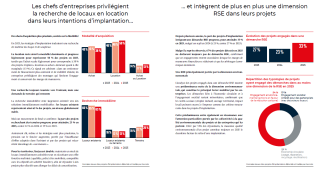
Illustration : © SCET - Ancoris
Methodology and extracts from Baromètre 2026
This barometer, published jointly by SCET (a subsidiary of Caisse des Dépôts) and Ancoris, is the third edition of an annual observatory combining two complementary sources: on the one hand, location project detection data from over 9,000 telephone interviews conducted by Ancoris with French and international business leaders; on the other, a qualitative survey of 156 regional decision-makers (local authorities, development agencies, public operators) conducted between October and December 2025. This dual approach - territorial supply and entrepreneurial demand - gives the document an analytical depth rare in this type of exercise. The title chosen, "Moving forward, despite everything", reflects a central tension that runs through the entire report: a slowdown in investment coexisting with optimism on the part of territorial players, two dynamics whose articulation reveals the structural fragilities of France's economic attractiveness.