SUMMARY
In 2023, almost 6 million people will have changed their main residence in France (excluding Mayotte). Between 2013 and 2023, the number of moves within the country fell (8.8% of the population in 2023 VS 10.8% in 2013), but to a lesser extent for long-distance residential mobility less strongly (1.5% changed region in 2023 vs. 1.7% in 2013). The health crisis has not altered this trend, although it has increased the distance of moves.
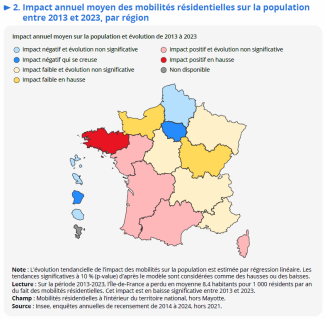
The residential attractiveness of the Atlantic seaboard regions (led by Brittany) and Occitanie is strong. The balance of residential mobility is improving in Bourgogne-Franche-Comté and Normandy, where it has become positive. On the other hand, the balance is negative and widening in Île-de-France.
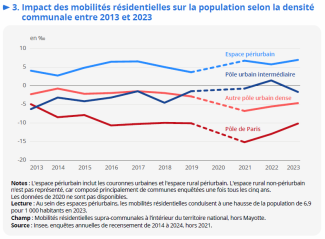
Inflows to major cities are declining, while peri-urban areas are gaining inhabitants as a result of residential mobility. Peri-urbanization is intensifying, with more people moving to lower-density areas.
The decline in mobility between 2013 and 2023 concerns all household types and all ages, with the exception of young people leaving high school. It is less pronounced for couples without children. The aging of the population and the growing proportion of older people, who are less mobile, are responsible for 14% of the overall decline in mobility over ten years.
Keywords: attractiveness, relocation, young people, households, metropolises, residential mobility, peri-urbanization, regions, aging population.
Illustration : Insee©
Illustrations Insee Première - n° 2073 - September 2025