SUMMARY
This study published by UNCTAD examines the adoption of artificial intelligence (AI) by Investment Promotion Agencies (IPAs) and is the most in-depth analysis to date of the use of AI and the digital transformation of public organizations in charge of economic and territorial attractiveness.
The report is based on interviews with pioneering agencies, nominations for WAIPA awards and analysis of 76 IPAs located in least developed countries and small island developing states. The aim is twofold: to draw up an inventory of existing uses and to propose an operational framework enabling IPAs at different levels of digital maturity to gradually integrate AI into their activities.
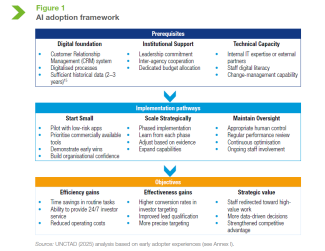
Its main contribution lies in demonstrating that AI is not just an automation tool, but a strategic lever for transforming intelligence, targeting, prospecting and investor relations functions. The examples of Estonia and South Korea show that the greatest benefits arise when AI is integrated into a coherent data ecosystem rather than used on an ad hoc basis. However, UNCTAD highlights the risks and challenges for agencies, and proposes a methodology for gradually integrating AI tools according to their degree of digital maturity (see Figure 1). Finally, there are few results to assess returns on investment, and no agency has set up a protocol to measure the causal effect of AI on attractiveness performance or FDI flows.
Keywords: investment promotion agencies, AI agents, economic attractiveness, attract invest, competitive advantage, automation, chatbot, data, user experience, governance, digital infrastructures, artificial intelligence, AI, discriminative AI, generative AI, predictive AI, organizational innovation, territorial marketing, performance, prediction, uses.
Illustration: UNCTAD © The IPA Observer
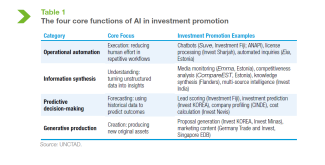
Tableau 1 (page 3) | L’IA appliquée à la promotion des investissements se répartit en quatre grandes fonctions complémentaires : automatiser les opérations, analyser et synthétiser l’information, prédire les résultats pour aider à la décision, et générer de nouveaux contenus.