ABSTRACT
The CSR Platform’s opinion paper offers an important analysis of the relationship between businesses and local communities. Its main contribution is to conceptualize territorial responsibility—not as a new form of corporate philanthropy, but as a dynamic of systemic and sustainable cooperation between businesses and local ecosystems.
The report highlights the factors driving this necessary shift: the ecological transition, resource scarcity, an aging population, skills shortages, digital transformation, regional vulnerabilities, and the pursuit of economic resilience. In this context, the challenges of competitiveness, ecological transition, social cohesion, productive sovereignty, and attractiveness can no longer be addressed separately. The objective isto identify the conditions necessary to transform businesses’ regional roots into a dynamic of sustainable cooperation among businesses, local governments, employees, associations, social and solidarity economy (SSE) actors, educational institutions, citizens, and other stakeholders.
Its main operational contribution lies inthe articulation of five levers: shared governance, cooperation, integration into regional policies, impact measurement, and mobilization of economic flows. Its main area of concern, however, is the ability to transform a concept that is still relatively new into an operational framework without excessively increasing administrative complexity, particularly for micro-enterprises and SMEs. The issue of measurement also represents a major challenge: the RTE can only truly become a framework for action if its effects can be documented in a robust, comparable, and “proportionate” manner (particularly relative to the size of businesses).
For local governments and economic development agencies, the shift is from a planning approach aimed at attracting business to a collective management approach of territorial resources and constraints. The strategic implication is significant: the challenge is no longer merely to promote a region, but to build and demonstrate the quality of its ecosystem. Territorial responsibility can thus be viewed as an interface between economic policy, ecological transition, social cohesion, skills development, public procurement, and regional attractiveness.
Keywords: territorial anchoring, territorial attractiveness, cooperation, territorial ecosystems, businesses, multilevel governance, territorial impact, corporate social responsibility (CSR), territorial corporate responsibility (TCR), transitions, shared territorial value, France.
Illustration: © France Stratégie - CSR Platform
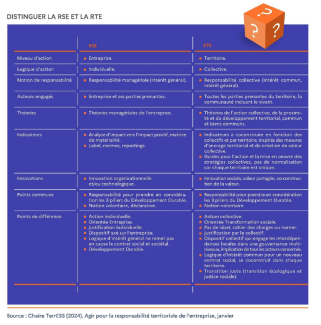
Differences Between CSR and TCR
To find out more :
- ADEME, October 2024, “An Overview of Industrial and Territorial Ecology in France in 2024.”
- TerrESS Chair, January 2024, Booklet “Taking Action in RTE”! Territories of the Social and Solidarity Economy.
- European Commission [WYG, Gautier, N., Petričević, T., D’Andrea, G. et al.], 2026, Impact-driven businesses in the EU – State of play and future prospects.
- TERR'ESS Chair Platform: Corporate Territorial Responsibility
- Les Ateliers du Futur, 17/09/2026, CAC 40 : moins d’un quart des grands groupes ont une trajectoire 2030 crédible.