SUMMARY
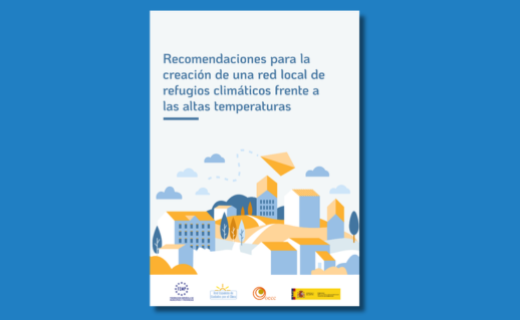
According to the European Environment Agency, heat waves represent the primary direct climate-related health threat to the European population. In Spain, the national meteorological agency has been documenting for several years a gradual increase in average temperatures, more intense extreme weather events, and a rise in the number of tropical nights. In 2024, 12,596 deaths in Spain were attributed to heat. In response to this situation,this guide (in Spanish) provides Spanish municipalities with a structured framework for designing, implementing, managing, and communicating about local climate refuge networks. It covers the entire lifecycle of such a system—from identifying spaces to communicating with citizens, including governance and activation protocols—thereby helping to strengthen local resilience to climate change.
Keywords: accessibility, adaptation, well-being, extreme heat, climate change, thermal comfort, public space, risk management, local governance, heat islands, territorial inequalities, vulnerable populations, climate refuge, resilience, health, urban planning, cities, Barcelona, Bilbao, Madrid, Málaga, Malgrat de Mar, Manacor, Murcia, Vitoria-Gasteiz, Spain.
Illustration: © Red de Ciudades por el Clima
To find out more :
- France Urbaine, June 23, 2026, COOL REFUGES: URBAN JURISDICTIONS EXPLORE THE OUTLINES OF A NEW CLIMATE RESILIENCE SERVICE.
- France Stratégie, juillet 2026, Améliorer la vie face aux canicules : pour une France du frais.
- F. de GASPERI, A. GRANDAZZI, F. OTTAVIANI et H. PICARD, 16/07/2026, Les refuges climatiques seront utiles s’ils n’oublient pas de faire de la chaleur un objet politique, The Conversation.
- Yann GILLIVER, 30 juin 2026, 'What preparedness looks like': Spain’s climate shelters praised for saving lives but what are they?, Euronews.
- Institut Paris Région, 18 juin 2026, Chaleur sur la ville.
- Rory JONES, 3 juillet 2026, The cooling divide: how air conditioning is creating a new climate inequality, The Conversation.
- Lucas MARTIN-BRODZICKI, 15 juillet 2026, Lyon ressort son plan d’urgence face à la canicule, Vert.
- Novethic x Calendar, Canicule 2026 : Cartographie des impacts de la chaleur.
- Toulouse Métropole, “Toulouse + fraîche” Plan
- Toute l'Europe, 03/08/2026, Canicule : toiles d’ombrage, galeries, patios, systèmes de refroidissement… comment les villes européennes se réinventent et s'adaptent face à la hausse des températures