SUMMARY
This Methodological Guide is set against the backdrop of a systemic socio-ecological crisis characterized by the documented overstepping of several planetary limits, growing urbanization and persistent social inequalities. The document takes as its starting point an observation now widely shared in scientific literature: the dominant approaches to sustainable urban planning, based on reducing negative impacts, offsetting or optimizing flows, are insufficient to meet the breadth and depth of contemporary challenges.
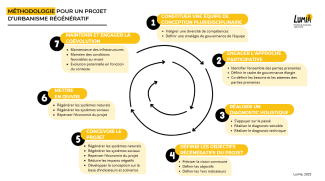
The report's stated ambition is twofold: firstly, to propose a conceptual framework clarifying what is covered by regenerative urbanism, a notion that is still emerging and sometimes blurred in operational practices; secondly, to offer a structured, reproducible and equipped methodology aimed at urban planning stakeholders wishing to go beyond conventional sustainability logics to actively contribute to the regeneration of ecological and social systems.
Keywords: adaptation, urban planning, participatory approach, systemic approach, land artificialisation, biodiversity, biomimicry, climate change, natural cycles, coevolution, cooperation, regenerative design, water, ecology, ecosystems, environment, governance, inclusion, social justice, quality of life, ecosystem services, territory, transition, regenerative urbanism, health, city, living.
Illustration: LUMIÅ ©