
SUMMARY
This chapter aims to investigate why and how strategic planning takes place in the French local public administration. The first part of the chapter starts by informing the French national context through the administrative system, the legal framework, the cultural and political factors, and the reform process. Recently, the state has undertaken a wave of reforms that has deeply redefined the institutional landscape and leaded to reinforce the region-metropole coupling in strategic planning. This kind of collaboration is actually imposed by the national state and refers to a top-down approach. Region and metropole levels have no other choice than to collaborate. In that sense, we observe “a recentralization movement of decentralization”. These reforms are leaded by a cost-cutting logic and tend to implement a rationalizing process. It also promotes a multi-level strategic decision process and an increasing influence of the civil society. In other words, we assume that the recent legal framework of local strategic planning is mainly influenced by the NPM and NPG paradigms. To investigate this assumption and provide new insights on why and how local authorities implement strategic planning activities, we undertook an empirical research.
The second part of the chapter aims to present the results of a research done on local authorities regarding the strategic planning process. Mixed methods were used for a more comprehensive understanding of the situation.
The third part of the chapter confirms that local strategic planning is influenced by NPM and NPG paradigms. It also provides new insights and a deeper understanding on process and practices used to implement local strategic planning. Our qualitative findings reveal the implicit logics behind such strategic activities. Finally, the discussion sheds light on local ideologies and institutional changes that shape local strategic planning in the French context.
Translation of the book chapter summary
Illustration : Adobe Stock - ©Daniel
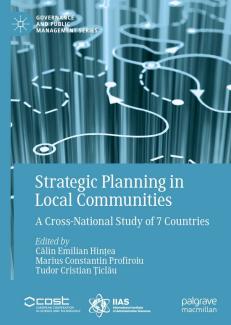
Il s'agit d'une étude comparative internationale des modèles de planification dans les gouvernements locaux. Alors que la planification stratégique est un domaine d'intérêt pour la gestion publique et les sciences administratives depuis plus d'un demi-siècle, il existe très peu d'études transnationales sur les spécificités de la planification au sein des collectivités locales.
Ce livre analyse les activités de planification des autorités locales dans sept pays différents : France, Hongrie, Roumanie, Russie, Espagne, Turquie et États-Unis. Bien que des modèles théoriques de planification stratégique soient utilisés, les conclusions de l'ouvrage mettent en évidence un environnement très diversifié et intéressant, où les facteurs culturels, politiques et juridiques jouent un rôle important dans la manière dont la planification est effectuée dans chaque pays.
Traduction du résumé de l'ouvrage Strategic Planning in Local Communities a Cross-National Study of 7 Countries
Have a question or comment?
Contact the authors of the book chapter
Laura CARMOUZE, Deputy Director of the Attractiveness and New Territorial Marketing Chair (A&NMT) - laura.carmouze@univ-amu.fr
Sarah SERVAL, Deputy Director, Chaire Attractivité et Nouveau Marketing Territorial (A&NMT) - sarah.serval@univ-amu.fr
Solange HERNANDEZ, Research Assistant and Head of the Master's program in Research, Studies and Consulting in Management Sciences/ Public Management specialization at the Institut de Management Public et Gouvernance Territoriale (IMPGT) - solange.hernandez@univ-amu.fr