SUMMARY
This analysis of the barometer on “Cultural Intervention in Rural Areas: A Survey in Auvergne-Rhône-Alpes” was published on April 23, 2026, by Samuel Périgois, a research fellow at the Observatory of Cultural Policies (OPC).
The survey was conducted in 2024 and 2025 among a panel of rural municipalities and intermunicipal communities in four departments in the Auvergne and Rhône-Alpes regions (Ain, Allier, Isère, Haute-Loire), in partnership with the Association of Rural Mayors of France.
The study documents the human and budgetary resources allocated to culture by low-density local governments, the facilities they manage (libraries, multipurpose halls, third places), as well as changes in the political priority given to culture in the face of budgetary constraints. It highlights recurring territorial logics in the stated policy objectives that primarily guide cultural decisions made by local executives (“attractiveness,” “proximity”) and underscores the foundational role of the nonprofit sector.
A specific section addresses the contractual mechanisms employed (CTEAC, the Leader program, “Small Towns of Tomorrow,” “Villages of the Future,” and CRTE) and the system of public cooperation betweendepartments, the national government, and local authorities. These cooperative approaches are utilized more by EPCIs than by municipalities.
💡 To learn more and explore the full report along with key findings:
Survey Methodology
-
Sample: a panel of rural communities in Auvergne-Rhône-Alpes (Ain, Allier, Isère, Haute-Loire) - 26 questionnaires collected in 2024 (11 municipalities, with populations ranging from 650 to 3,426 residents, and 15 intermunicipal associations) and 21 questionnaires collected in 2025 (8 municipalities, population ranging from 985 to 3,426 residents, and 13 intermunicipal associations) - 20 local governments responded to both rounds. The sample was selected based on the zoning of urban catchment areas (areas with fewer than 50,000 residents or outside urban catchment areas) and according to INSEE’s municipal density grid (categories 5, 6, and 7: rural villages and rural areas with scattered or highly scattered settlements), with an effort to identify a corresponding municipality or community of municipalities.
-
Survey period: 2024 (April through August) and 2025 (late March through September)
-
Method: Self-administered online questionnaire, sent via email primarily to elected officials (municipalities) and technical staff—DAC, cultural affairs officers, DGS, or other department heads (intermunicipal bodies). Self-reported data, processed anonymously and aggregated using Sphinx.
-
Conducted by: Observatoire des politiques culturelles (OPC), with support from the Ministry of Culture (DEPS and DGDCER) and in partnership with the Association of Rural Mayors of France (AMRF).
OPC Barometer Word Cloud
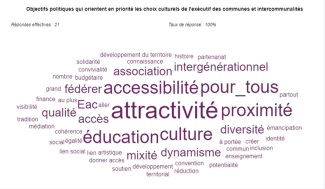
Nuage de mots intitulé « Objectifs politiques qui orientent en priorité les choix culturels de l'exécutif des communes et intercommunalités ».
Le graphique est basé sur 21 réponses, avec un taux de réponse de 100 %. Les mots les plus mis en avant sont « attractivité », « accessibilité pour tous », « proximité », « culture » et « éducation », indiquant qu'ils sont les objectifs les plus fréquemment cités.
D'autres termes apparaissent en taille intermédiaire : « intergénérationnel », « diversité », « dynamisme », « mixité », « fédérer », « association », « accès » et « qualité ». De nombreux mots plus petits complètent le nuage, notamment « développement du territoire », « partenariat », « solidarité », « convivialité », « inclusion », « identité », « visibilité », « histoire », « soutien », « cohérence », « médiation », « lien social », « égalité », « enseignement » et « potentiel ». La taille des mots reflète leur fréquence d'apparition dans les réponses.