SUMMARY
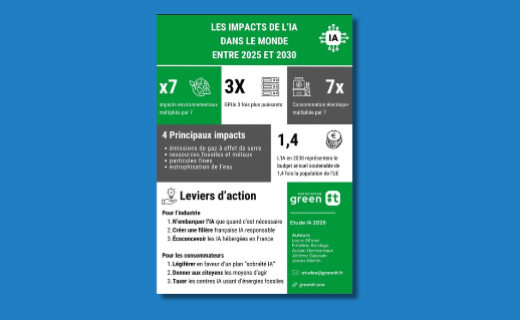
The Green IT association, a collective of experts in responsible digital technology, will publish the second edition of its study on the environmental and health impacts of artificial intelligence worldwide in September 2026. The study was conducted using theLife Cycle Assessment (LCA ) method (ISO, European PEF, ADEME guidelines).
The global installed base, estimated at 13 million dedicated servers in 2025, is projected to reach 25 million by 2030. AI’s environmental footprint centres on four impacts: global warming (35 per cent), water eutrophication (23 per cent), resource depletion (19 per cent) and fine particulate matter (15 per cent). Electricity generation accounts for up to 96 per cent of this, whilst equipment manufacturing accounts for up to 45 per cent of the impact on certain resources. Greenhouse gas emissions are projected to surge from 99 to 636 million tonnes of CO₂ equivalent between 2025 and 2030 – 1.4 times the European Union’s annual sustainable budget. The study highlights a dynamic where supply creates demand, with AI features largely being imposed on users. It calls on public authorities to introduce legislation (AI efficiency, labelling, eco-design, and a bonus-malus tax system for centres powered by fossil fuels). These are all regulatory frameworks that must be anticipated for any project to establish a data centre in a given region.
Keywords: LCA, data centre, eutrophication, eco-design, carbon footprint, digital frugality, greenhouse gases, Green IT, digital infrastructure, electricity mix, regulation, environmental responsibility, server, digital frugality, sustainability